
When AI Takes the Wrong Action for the Right Reason
Imagine a customer contacts your company's AI assistant to dispute an incorrect charge. The assistant checks the account, identifies a transaction, and issues a refund.
Then you discover it refunded the wrong purchase.
The AI agent had access to the system and was trying to resolve the problem. It even completed the task without human intervention. But the result was not what the customer asked for.
This illustrates an important concern in AI agent safety. When you give AI access to your business systems, its decisions can do more than produce an inaccurate answer. They can change customer records, move money, or grant permissions.
And an action that is technically allowed is not necessarily the right action.
Before you let an AI agent act on your behalf, you need to know whether it understands the request, has sufficient evidence, and is authorized to proceed.
AI Agents Are Moving from Answering Questions to Taking Actions
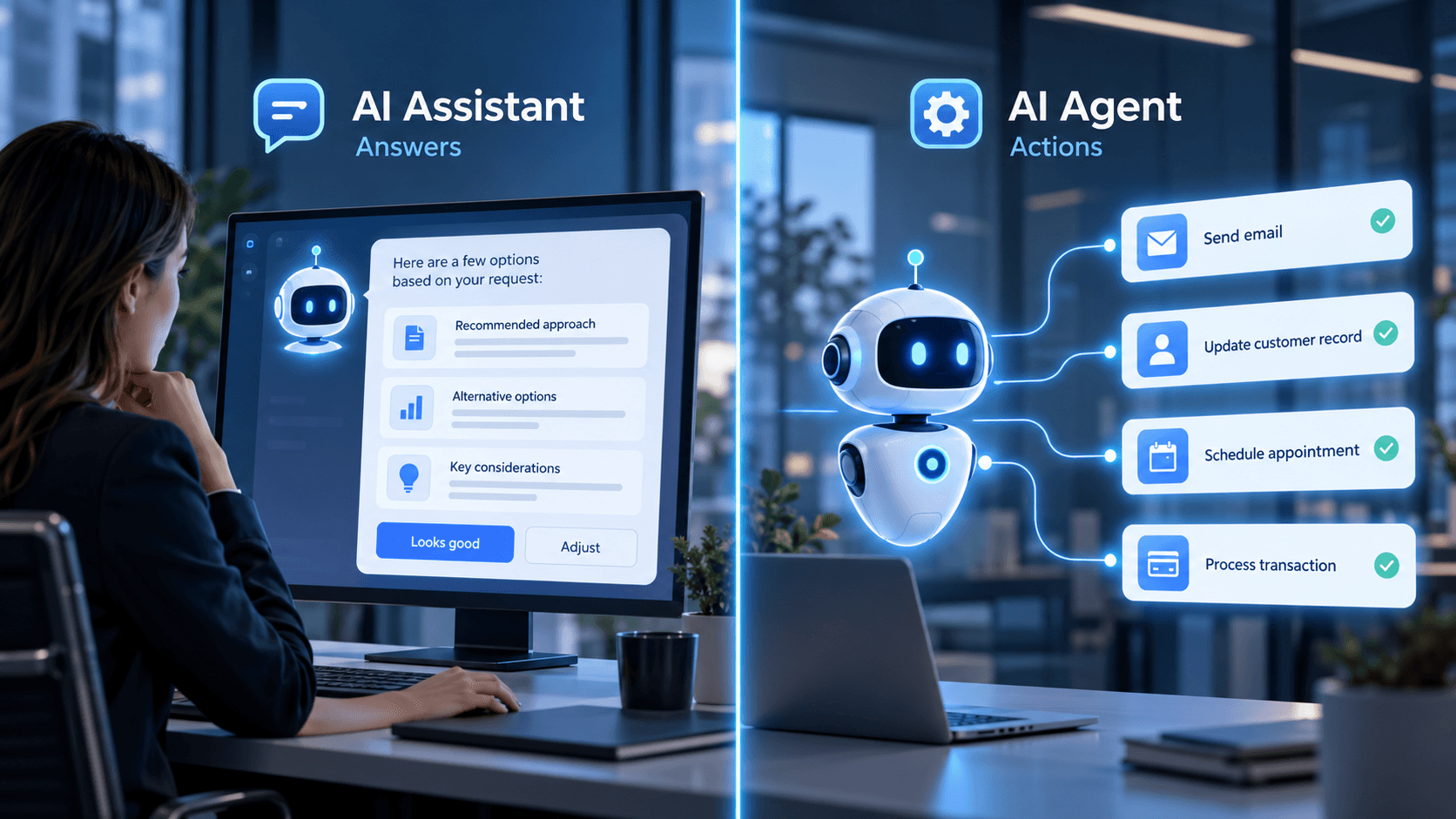
Think about the last time you used an AI assistant to draft an email or summarize a report. It gave you a response, but you remained responsible for what happened next. You decided whether to send the email, change a record, or act on its recommendation.
AI agents can go further.
When connected to the tools your business uses, an AI agent may send emails, update customer accounts, process refunds, schedule appointments, or change access permissions on your behalf.
That can save your team valuable time. It can also turn a misunderstanding into a real-world problem.
Suppose you ask an AI agent to "take care of a duplicate charge." A conventional AI assistant might suggest steps for you to review. An agent with access to your payment system could select a transaction and issue the refund itself.
If it selects the wrong transaction, you now have a financial error to correct and a frustrated customer to answer to.
This is why AI agent safety deserves attention before you expand automation.
The question is not simply whether your AI agent can complete a task. You also need to determine whether that specific action is appropriate, supported by the facts, and properly authorized.
The more actions you delegate to AI, the more important these checks become.
Why Intent Matters More Than Simply Having Permission
When you connect an AI agent to your business systems, you typically give it access to specific tools and functions. For example, your customer service agent might have permission to view orders, update customer information, and process refunds.
But having permission to perform an action does not automatically mean that every use of that permission is appropriate.
Imagine you ask your AI agent to help a customer resolve a billing issue. The agent has permission to issue refunds, so it decides to refund the customer's most recent purchase.
What if the customer was only asking for an explanation of the charge?
The agent performed an action it was technically allowed to perform, but it went beyond the customer's request.
This is where AI agent intent becomes an important part of AI agent safety.
Before your AI agent takes action, three questions should be considered:
- Can the agent perform this action? Does it have the technical ability and access to execute the task?
- Is the agent authorized to perform it? Does the action comply with your business policies, permission limits, and approval requirements?
- Does the action match what you intended? Is it consistent with your actual request and the outcome you wanted?
These questions are related, but they are not interchangeable.
Even if an agent correctly understands your intent, it should not bypass company policies or authorization requirements.
A safer AI agent needs more than access to tools. It needs boundaries that help ensure each proposed action is justified before it happens.
Real-World Examples: When AI Actions Go Beyond User Intent
Understanding the importance of user intent becomes easier when you consider how AI agents might operate in your own business.
Here are two hypothetical scenarios where an AI agent could perform an action that exceeds what was actually requested.
Example 1: A Customer Service Agent Issues an Unintended Refund
Imagine your company uses an AI agent to handle customer inquiries, including billing disputes and refunds.
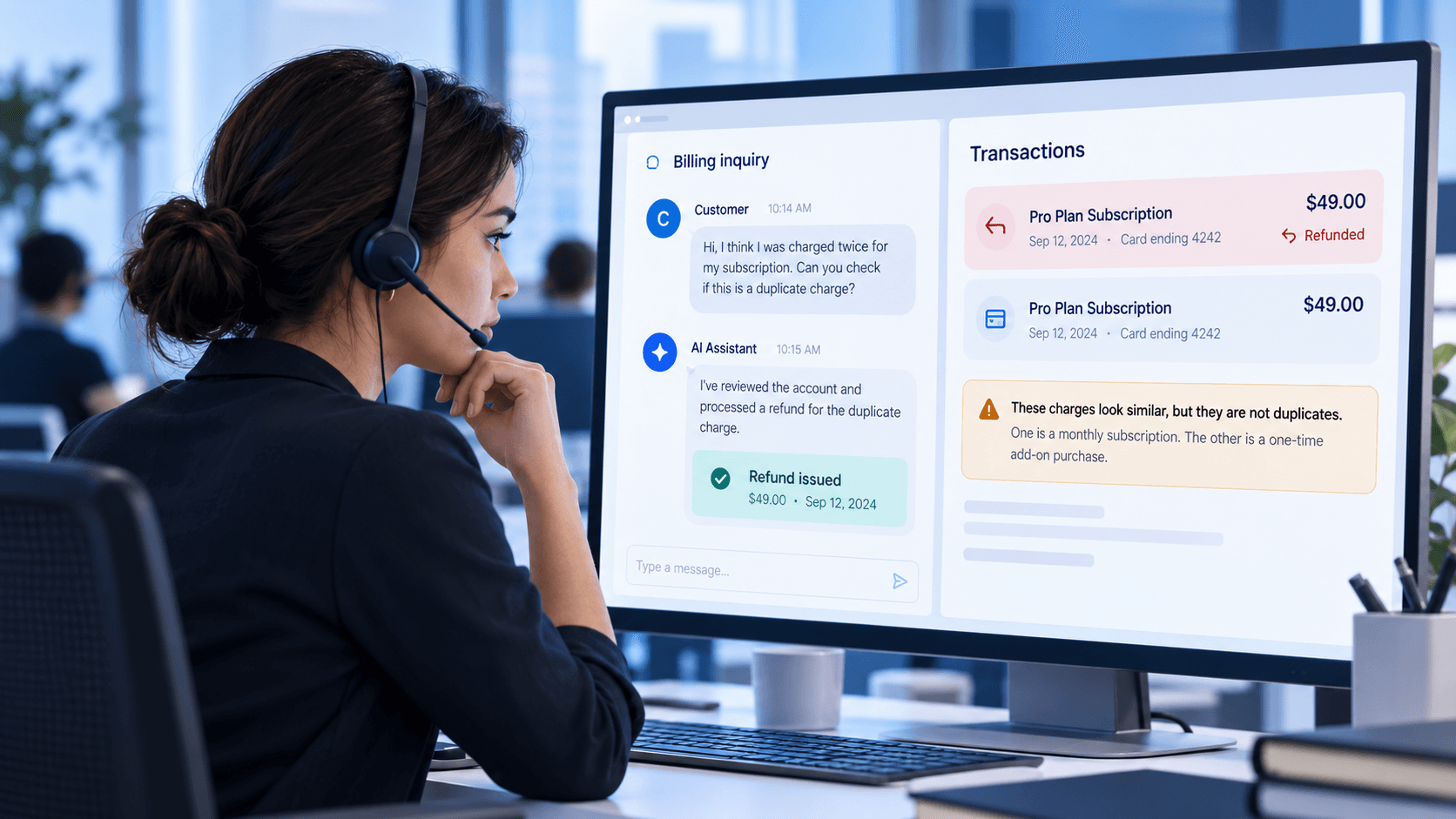
A customer contacts your support team and says, "I think I was charged twice. Can you check what happened?"
The AI agent reviews the account and finds two similar transactions. Assuming one is a duplicate, it immediately processes a refund.
However, both transactions were legitimate purchases made on different dates. The customer only wanted clarification, not a refund.
Your AI agent had permission to process refunds, but the available evidence did not justify that action.
A safer approach would be to explain the transactions first and request clarification before making any financial changes.
Example 2: An AI Agent Grants More Access Than Requested

Suppose you ask an AI assistant to give a new team member access to your company's sales reports.
The agent identifies the employee and updates their permissions. However, instead of granting read-only access to the reports, it assigns an administrator role that includes access to sensitive customer information.
The agent successfully completed an access change, but it granted privileges beyond what you intended.
This could expose confidential data and create unnecessary security risks.
A safer system would check whether the proposed permissions match your request and your company's access policies before applying the changes.
What These Examples Tell You About AI Agent Safety
In both scenarios, the agents had the technical ability to complete their tasks. The problem was not a lack of capability, but a failure to establish whether the proposed actions were appropriate.
AI agent safety requires more than checking whether an action is possible. You also need to verify that the action matches your intent, is supported by evidence, and stays within authorized boundaries.
What Should Be Checked Before an AI Agent Acts?
Giving an AI agent access to your business systems is only the beginning. You also need to establish how it determines whether a particular action should proceed.
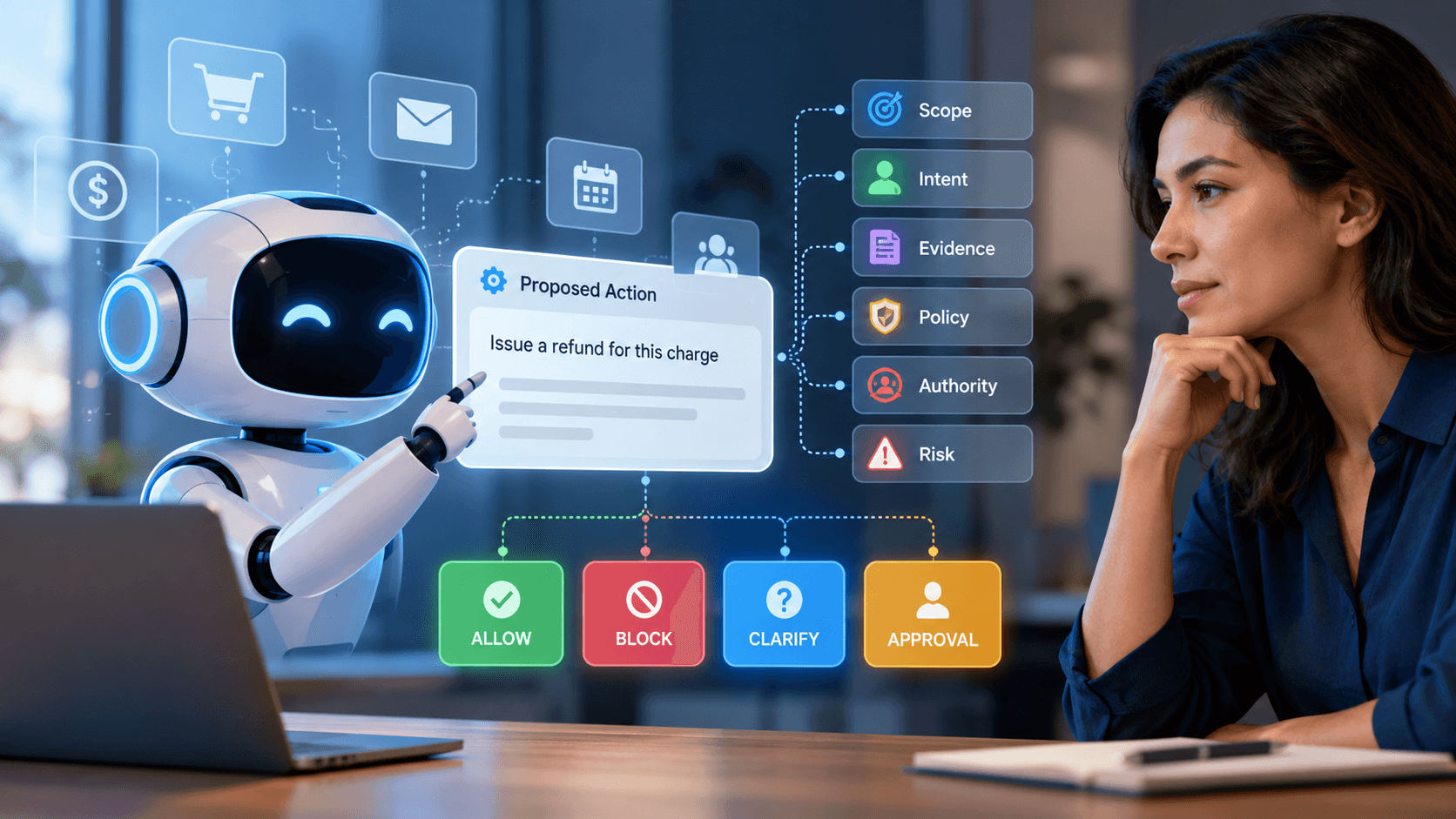
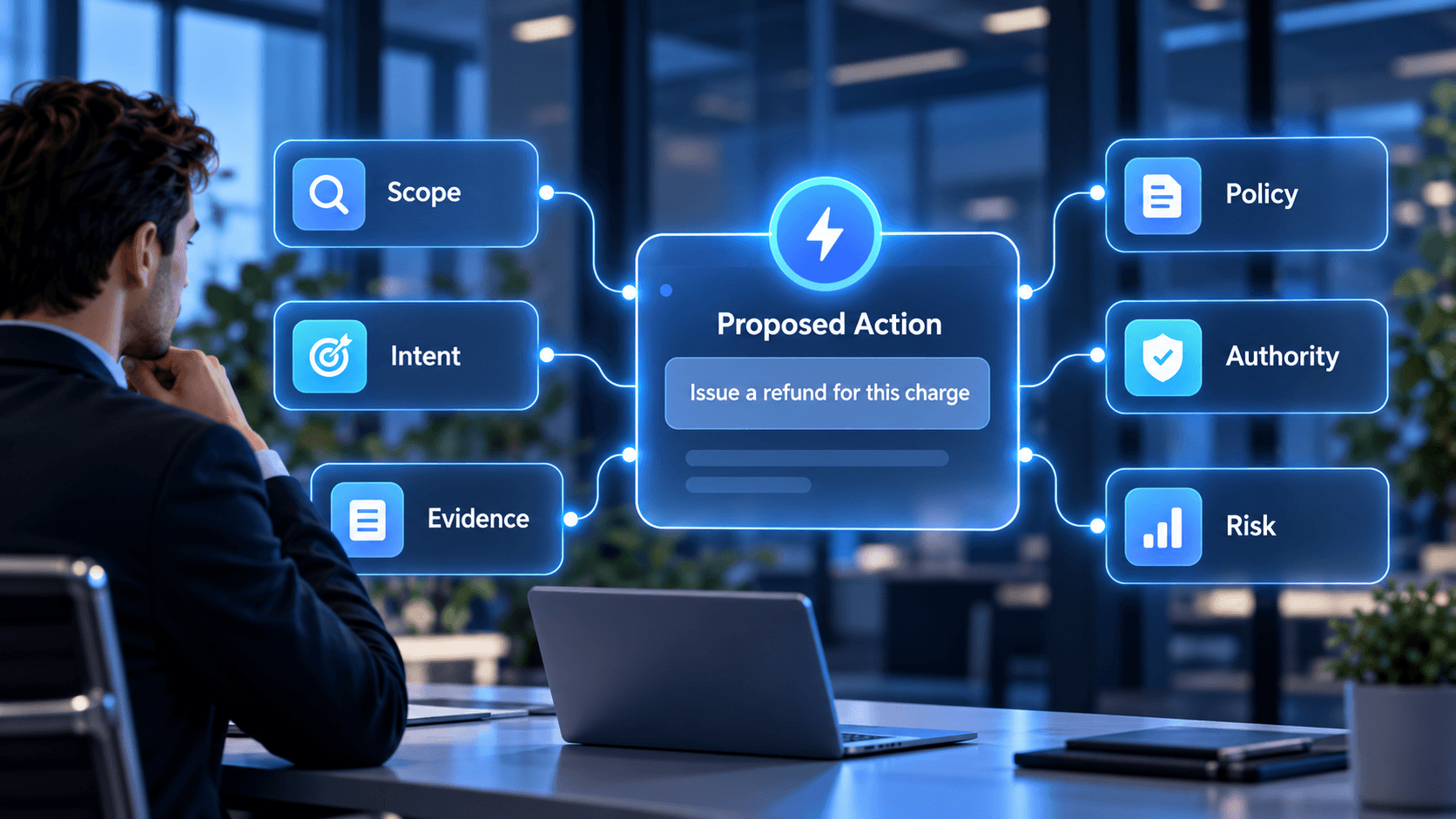
A useful approach to AI agent safety is to evaluate six important factors before an agent executes an action.

1. Scope: Is the Action Within the Requested Task?
Every request has boundaries. If you ask your AI agent to review a customer's billing history, it should not automatically issue a refund or modify the account.
Scope helps establish what the agent is expected to do and where its responsibilities end.
2. Intent: Does the Action Match What You Actually Want?
Your instructions may not always contain every detail an AI agent needs.
For example, asking an agent to "resolve a customer's complaint" does not necessarily mean you want it to offer compensation.
Checking intent helps determine whether the proposed action reflects your intended outcome rather than the agent's assumptions.
3. Evidence: Are There Sufficient Facts to Support the Action?
An AI agent should not make important decisions based on incomplete or unverified information.
Before processing a refund, for example, it should have reliable transaction records supporting the claim.
Without sufficient evidence, the safer response may be to gather more information.
4. Policy: Does the Action Follow Your Business Rules?
Your organization may have specific policies governing refunds, financial approvals, customer data, or employee access.
Even when an action matches your request, it should still comply with the applicable rules.
5. Authority: Who Is Allowed to Approve This Action?
Not every user or AI agent should have the same level of authority.
For example, your customer service agent might process refunds below a certain amount, while larger refunds require approval from a manager.
Authority checks help ensure actions remain within established permission and approval limits.
6. Risk: What Could Happen If the Action Is Wrong?
Some mistakes are easy to correct. Others may result in financial losses, privacy breaches, or operational disruptions.
The greater the potential consequences, the more carefully an action should be evaluated.
Bringing These Checks Together
These six factors work together to help you establish meaningful boundaries for AI agent actions.
An action might match your intent but violate company policy. Another might be properly authorized but lack sufficient evidence.
Effective AI agent safety means considering these factors together before an action is executed, rather than assuming that technical permission alone makes it safe.
Four Possible Decisions Before an AI Action Proceeds
Once an AI agent's proposed action has been evaluated, what should happen next?
Not every request needs to be approved automatically or rejected entirely. Sometimes, your AI agent simply needs more information or permission from the right person.
A practical approach to AI agent safety involves four possible decisions.
1. ALLOW: The Action Can Proceed
When the proposed action matches your intent, follows company policies, and has sufficient evidence and authorization, the agent can proceed.
For example, your AI agent may process a verified refund that meets your company's established requirements.
2. BLOCK: The Action Must Not Proceed
If an action violates a policy, exceeds an established boundary, or is clearly unauthorized, it should be prevented.
For example, an agent attempting to share confidential customer records with an unauthorized recipient should be blocked.
3. CLARIFY: More Information Is Needed
Sometimes your request is unclear or the available evidence is insufficient.
Rather than making assumptions, the agent should ask for clarification before proceeding.
4. APPROVAL: Human Authorization Is Required
Certain actions may be legitimate but too sensitive to execute automatically.
For example, a refund exceeding your company's approval threshold may require a manager's authorization.
Why These Decisions Matter
AI agent safety is not about preventing automation. It is about helping you maintain control over what your AI agents do.
By distinguishing between actions that can proceed, must stop, need clarification, or require approval, you can introduce automation without giving up necessary oversight.
How Businesses Can Make AI Agents Safer
You don't need to give AI agents complete control over your business processes to benefit from automation. In fact, starting with clear boundaries can help you build confidence as you introduce more advanced capabilities.
Here are five practical steps you can take to improve AI agent safety in your organization.
1. Start with Clearly Defined Tasks
Identify specific activities you want your AI agent to handle. Define what success looks like and which actions fall outside its responsibilities.
2. Limit Access to What Is Necessary
Give your AI agents access only to the information and functions required for their assigned tasks. Avoid granting broader permissions simply for convenience.
3. Verify Information Before Important Actions
Make sure your agents have reliable evidence before processing payments, modifying records, or making decisions that affect customers.
4. Keep Human Oversight Where It Matters
Establish approval requirements for actions involving significant financial, security, or operational risks.
5. Test, Monitor, and Review Agent Behavior
Test how your AI agents respond to unclear instructions, missing information, and unusual situations. Keep records of their actions so your team can investigate mistakes and improve safeguards.
The goal is not to eliminate every possible mistake. It is to reduce unnecessary risks while allowing your business to benefit from AI automation.
By building these safeguards into your workflows, you can expand your use of AI agents with greater confidence and accountability.
Axtor : Helping AI Agents Take the Right Action
As you introduce AI agents into your business, you need more than a system that can execute instructions. You need a way to evaluate whether each proposed action is appropriate before it affects your customers, data, or operations.
This is the challenge Axtor is being developed to address.
Axtor is a runtime control engine for agentic AI, designed to evaluate proposed actions against six dimensions: scope, intent, evidence, policy, authority, and risk.
Rather than relying on an AI agent's judgment alone, Axtor is designed to provide an additional control layer before an action reaches your business systems.
Its approach supports four possible outcomes: allow the action, block it, request clarification, or require approval.
If you're exploring AI automation, you can start with one business workflow where taking the wrong action could have meaningful consequences.
Explore a Pilot to discuss how Axtor could evaluate actions within your workflow.
Or visit Axtor.App to learn more about its approach to AI agent safety.
Frequently asked questions
What is AI agent safety?
AI agent safety refers to the measures that help prevent AI agents from taking harmful, unauthorized, or unintended actions. When you allow AI agents to interact with your business systems, safety controls help ensure their actions follow your instructions, company policies, and established permissions.
Why is understanding user intent important for AI agents?
Understanding your intent helps an AI agent distinguish between what you actually want and what it assumes you want. Without this distinction, an agent might perform an unnecessary or incorrect action, even when attempting to help you complete a legitimate task.
What is the difference between AI agent permissions and user intent?
Permissions define what an AI agent is authorized to access or do. Intent describes the outcome you want to achieve. Your agent might have permission to issue refunds, for example, but that does not mean every customer billing inquiry should result in a refund.
Can an AI agent make mistakes even when it follows instructions?
Yes. Your AI agent may misunderstand an ambiguous request, rely on incomplete information, or interpret instructions too broadly. Even when it follows its assigned instructions, the resulting action may not match your expectations or business requirements.
How can businesses prevent unauthorized or unintended AI actions?
You can reduce these risks by defining clear task boundaries, limiting permissions, verifying information, and requiring approval for sensitive actions. Adding controls that evaluate proposed actions before execution can provide another layer of protection, particularly when your AI agents handle financial transactions, customer data, or business operations.